Events
Playing Jazz in an Industry Full of Solo Acts
May 5, 2026
Madison Wharton
The biggest wave of agency consolidation in a generation is a stress test. As mega-networks merge and generalist scale becomes the dominant logic, the value of specialist talent will be tested, as will the theory that these consolidations result in successful collaboration models.
Adrian Co’s jazz ensemble analogy is useful here. Each musician is a virtuoso. Together, they're not competing, they're complementing, responding, enhancing, each taking the lead as the moment demands. The result is something none could create independently. That's the model the creative industry has always claimed to want and consistently failed to build.
If you ever felt like an ‘integrated’ agency was quietly competing with itself, you were right. I've watched the failure up close. As a senior leader at a holding company agency, I sat at a client dinner and listened, unrecognised, as the president of our sister agency undermined my team's capabilities to our shared client. The following week, the workstream moved to that office. We were supposedly one agency.
This wasn't an anomaly. Leadership announces an 'integrated model' to win a client. Teams dive into foxholes. We sold seamless collaboration to clients while operating in the exact silos we promised to dismantle. The reason is predictable: when compensation and advancement are tied to individual company performance, people protect territory. It's not a culture problem. It's a systems problem. For clients, that system failure shows up as duplicated briefs, senior talent that pitched but never delivered and budgets absorbed by internal friction you never agreed to fund.
AI Raises the Stakes
AI has entered the creative industry as a universal disruptor, but how we adapt is anything but uniform. Branding studios are developing AI workflows that look nothing like those at experience companies or media agencies. The distinction between generic AI implementation and specialist craft-enhancing AI is already visible in the work.
A 2025 Technology in Society study found something more unsettling than homogenisation: it compounds. Months after people stopped using AI tools, their work kept getting more generic. The researchers called it a 'creative scar': AI makes you feel more creative while quietly making you less so. They called that gap the 'creativity illusion.'
Specialists are the antidote. A motion design studio using AI doesn't prompt 'make an animation.' They build sophisticated pipelines that integrate AI at specific points while preserving the human expertise that defines their aesthetic. Generic AI implementations create generic work. Specialised AI implementations elevate human creativity.
This creates a massive opportunity, but only for organisations that can connect specialists across disciplines. Which brings the collaboration problem back to centre.
Designing for Collaboration
The organisations getting this right didn't retrofit collaboration onto competitive structures, they built systems for it from the start. That means shared R&D across distinct companies, cross-disciplinary working groups, and compensation models that reward collaborative wins rather than individual P&L protection.
The proof shows up in the work. When a former tech client joined a financial services brand, she pulled from three separate specialist companies within a single network: a brand redesign that expanded to include growth strategy and event execution. Three independent teams, one seamless client relationship. That kind of engagement was possible because the network was structured to make it the path of least resistance.
None of it requires special virtue. It requires designing systems that reward the behaviour you actually want.
The jazz ensemble doesn't work because musicians are told to collaborate. It works because the structure demands listening. As the industry consolidates around scale, the organisations that last won't be the loudest. They'll be the ones that learned to play together.
As originally appeared in Little Black Book, https://lbbonline.com/news/Playing-Jazz-in-an-Industry-Full-of-Solo-Acts
Madison Wharton is the chief operating officer of Residence
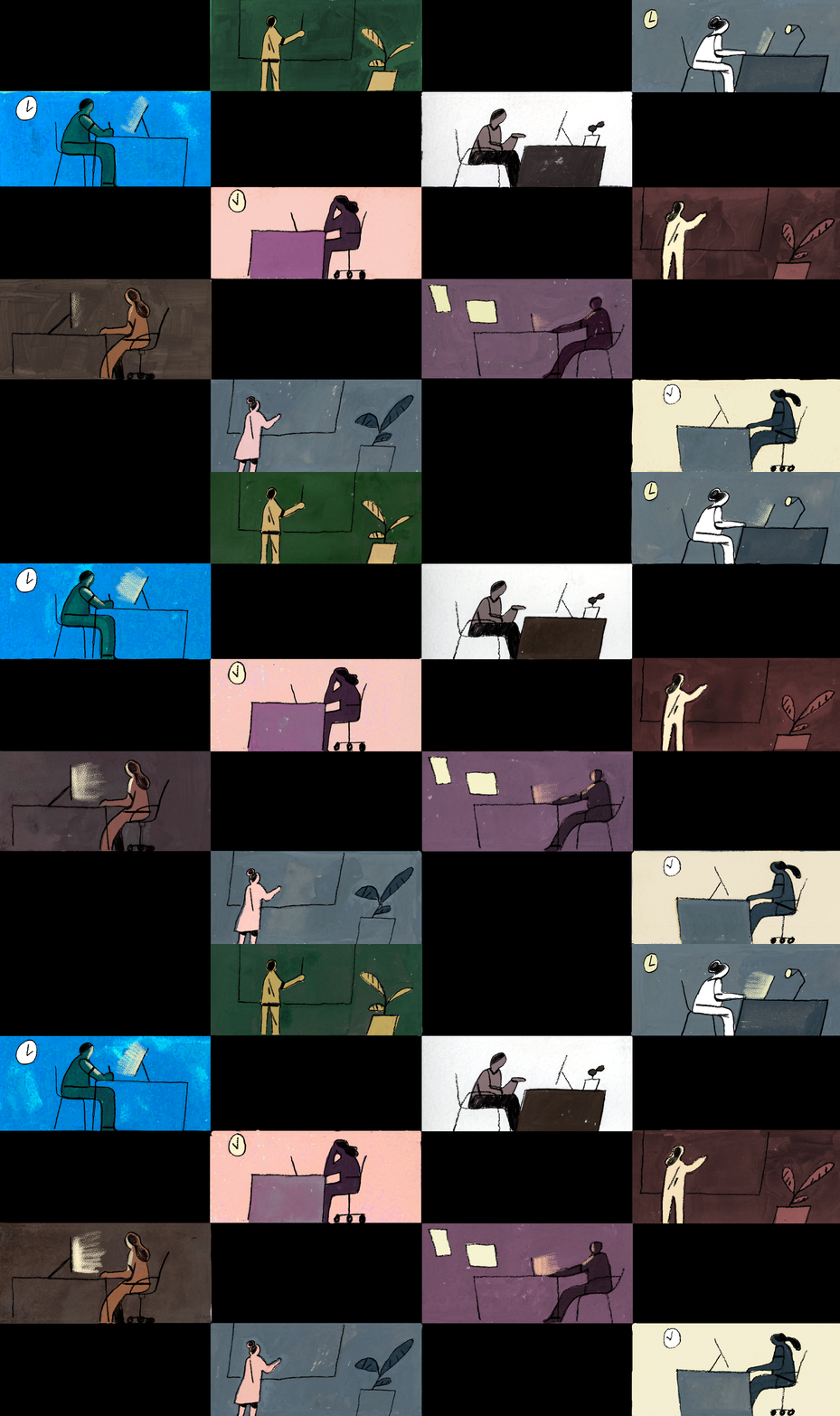
Illustration by Jamiel Law, BUCK